Connected Homes, Clear Choices
The everyday task improved: Shifting water-heater, underfloor heating, and EV charging loads away from expensive morning electricity tariff spikes, and alerting occupants when CO2 or radon rises in a tightly insulated winter home—without sending personal occupancy patterns to a third-party cloud server.
Few regions test home automation quite like the Nordics. In Norway, Sweden, and Finland, dynamic hourly electricity pricing (tied to the Nord Pool wholesale market) and capacity-based grid tariffs (effektledd) mean that running an electric boiler, sauna stove, and vehicle charger simultaneously at 08:00 in January carries an immediate financial penalty. Meanwhile, triple-glazed windows and tight vapor barriers keep heat inside, making mechanical ventilation and accurate air monitoring essential rather than optional.
Why the Radio Protocol Matters: Trondheim's Silicon Legacy
A large share of the world's low-power wireless devices rely on radio architectures engineered in Trondheim and Oslo by Nordic Semiconductor (notably the nRF52, nRF53, and nRF54 series systems-on-chip). Understanding why these chips exist clarifies what makes a good home sensor versus a frustrating one.
Many mass-market smart plugs and sensors use cheap Wi-Fi modules originally intended for continuous data streaming. Because Wi-Fi handshakes consume tens or hundreds of milliamps, a battery-powered Wi-Fi door or temperature sensor drains its cells in months, while twenty mains-powered Wi-Fi relays easily congest a consumer router's airtime. By contrast, IEEE 802.15.4 mesh protocols—specifically Zigbee and Matter over Thread—wake up in milliseconds, transmit a tiny encrypted packet at a fraction of the energy, and go back to deep sleep drawing less than two microamps.
The Non-Negotiable Rule for Home Hardware: The Wall-Switch Test
Before installing any connected relay, dimmer, or thermostatic radiator valve (TRV), we apply a simple domestic rule: If a guest walks into the room without a smartphone, or if the fiber internet cable outside is severed by an excavator, does the room still work?
-
Pass: Inline Puck Relays Behind Existing Switches
The physical wall switch continues to toggle the ceiling lamp directly via its wired input terminal, while local Zigbee/Thread scenes remain optional conveniences.
-
Fail: Cloud-Dependent Smart Bulbs With Taped-Over Wall Switches
If someone flips the physical switch off, the bulb becomes unreachable; if the vendor's cloud server lags, the hallway stays dark.
Direct Utility Meter Reading via the HAN / P1 Port
Instead of clamping imprecise current transformers around mains cables, smart meters across the Nordic grid expose a local RJ45 or RJ12 Home Area Network (HAN / P1) port. A compact reader powered directly from the meter's 5V bus parses real-time active power, phase amperage, and cumulative kilowatt-hours every two seconds.
When paired with a local controller (such as an open-source Home Assistant box or a local Nordic energy gateway), this two-second feedback loop enables automatic load shedding. If turning on an induction cooktop pushes Phase L1 above a 10 kW hourly tariff threshold, the controller temporarily pauses the bathroom floor heating thermostat or steps down the garage EV charger current from 16A to 6A for twenty minutes. The occupant notices zero change in floor temperature—concrete slabs store heat for hours—while avoiding a full month's higher grid capacity bracket.
Indoor Air Quality: Radon, CO2, and Relative Humidity
Granite bedrock across large parts of Norway, Sweden, and Finland makes indoor radon gas a documented health metric rather than a theoretical curiosity. Traditional charcoal canister tests require mailing a sample to a laboratory and waiting weeks for a single average number. Oslo-based pioneers such as Airthings popularized continuous passive alpha-spectrometry sensors that run for years on two AA cells, revealing how radon levels fluctuate when basement air pressure drops during winter storms.
Alongside radon, true non-dispersive infrared (NDIR) or photoacoustic CO2 sensors (such as the Sensirion SCD41) provide actionable data in bedrooms and home offices. Beware of cheap "eCO2" (equivalent CO2) sensors sold in novelty gadgets: those devices merely measure volatile organic compounds (VOCs) with a metal-oxide resistor and guess CO2 levels mathematically, triggering false alarms whenever someone peels an orange or makes coffee.
| Home Subsystem | Recommended Local Interface | Standby Draw | Maintenance Schedule |
|---|---|---|---|
| Smart Meter HAN Reader | RJ45 M-Bus / P1 to local MQTT or Zigbee | ~0.15W (from meter) | None; verify local encryption key once |
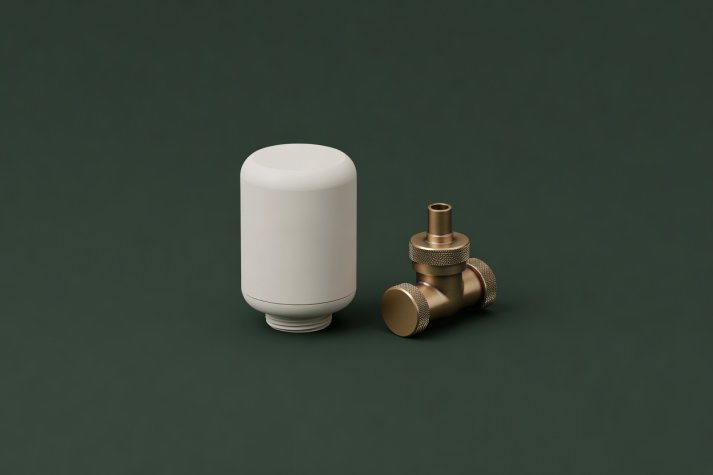
| Radiator Valve Actuator | Thread / Zigbee 3.0 with brass M30×1.5 nut | 2× AA alkaline (2 yrs) | Run anti-calcification valve cycle in summer |
| Radon & CO2 Monitor | BLE / Sub-GHz or Thread; e-paper display | 2× AA lithium (3 yrs) | Expose to 420 ppm outdoor air yearly for CO2 baseline |
| Water Leak Puck | Gold-plated floor probes; local siren + valve shutoff | 1× CR2477 (5 yrs) | Test probe continuity with damp cloth every autumn |
Hardware longevity in both portable tools and fixed home sensors depends heavily on what surrounds the circuit board. Continue to Materials That Make Sense to see how enclosure polymers, metals, and textiles hold up over time.