Repair Before Replacement
The everyday task improved: Replacing a worn headphone ear cushion, a fatigued lithium battery, or a loose USB-C charging port at home in fifteen minutes with a single screwdriver—rather than shipping the entire product to a service center or buying a replacement.
In Norway, the Consumer Purchase Act (Forbrukerkjøpsloven) grants a five-year statutory reclamation period (reklamasjonsrett) on products meant to last substantially longer than two years, including computers, phones, audio systems, and smart home hardware. Across Sweden, Denmark, and Finland, strong consumer protection traditions combined with the European Union's Ecodesign for Sustainable Products Regulation (ESPR) and portable battery replaceability mandates have turned repairability from an hobbyist preference into a core engineering discipline.
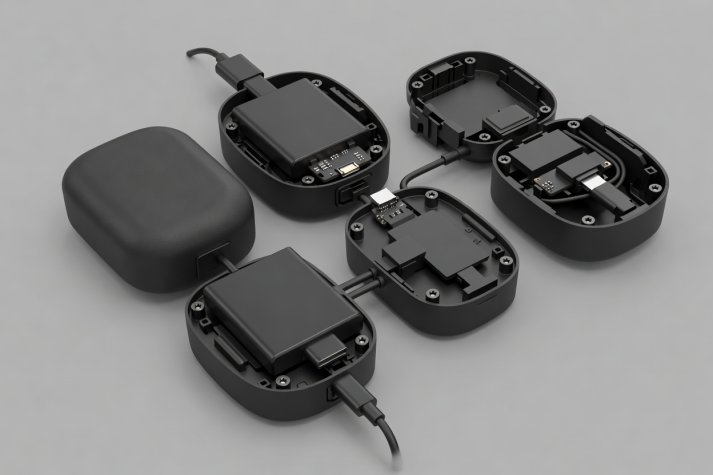
Isolating the Three Failure Points
When we perform teardowns of household gadgets, 85% of hardware failures outside of liquid immersion trace back to just three components: the chemical cell, the physical power/audio jack, and elastomeric pads or cushions. Digital logic chips, amplifiers, and passive resistors comfortably run for fifteen to twenty years if kept within thermal limits.
Thoughtful Scandinavian hardware architecture isolates those three high-wear parts from the main logic board:
-
Daughterboard I/O Ports
Instead of soldering the USB-C receptacle directly onto the expensive four-layer main PCB (where a tripped-over cable can rip copper traces off the board), repairable devices mount the USB-C port on a €4 sub-board connected via a flexible ribbon cable.
-
Tray-Mounted Batteries with Pull-Tabs or JST Connectors
Whether in Bang & Olufsen's Mozart-platform speakers in Struer or AIAIAI's TMA-2 modular studio headphones in Copenhagen, batteries sit in dedicated screw-down compartments with plug-in molex connectors—never glued down over fragile display ribbons.
-
Uniform Screw Lengths
Nothing causes more accidental repair damage than mixing 3.2mm and 4.5mm screws inside the same device; driving a long screw into a short boss punctures the front enclosure. Clean mechanical engineering uses a single Torx T6 or T8 screw size throughout the outer housing.
Hardware Survival Without Firmware Abandonment
Physical repairability is wasted if a connected speaker or sensor becomes unusable when a manufacturer retires its smartphone app five years later. In our assessments, a device only earns full longevity credit if it supports at least one unencrypted, standardized local fallback:
For audio equipment, that means a physical 3.5mm TRS line-in jack, USB-C class-compliant DAC mode, or standard Bluetooth Classic profile that requires no setup app. For smart home sensors and actuators, it means factory-resetting and pairing directly over open Zigbee 3.0 or Matter over Thread using a printed QR/setup code stamped inside the battery lid.
Kitchen-Table Maintenance Checklist
Even well-built hardware benefits from ten minutes of preventive care once a year. Before assuming a gadget has failed electronically, check the mechanical basics:
| Symptom | Likely Mechanical Cause | 10-Minute Remedy |
|---|---|---|
| USB-C cable wobbles or drops charge | Compacted pocket lint at the bottom of the receptacle | Power off; gently clear lint from port floor using a wooden toothpick (never a metal needle) |
| Rotary dial skips values or jumps | Dust or oxidation on mechanical encoder contacts | Pull off knob cap; apply one drop of plastic-safe contact cleaner (e.g., PRF 7-78) and rotate 30 times |
| Air sensor reports sluggish humidity | Dust film clogging the PTFE membrane filter over sensor opening | Brush vent gently with a dry soft bristle brush; never blow compressed air directly into sensor port |
| Cordless device stored over summer | Lithium cell stored at 0% or 100% state of charge | Charge or discharge to ~50–60% before storing in a cool cupboard (15°C) |
Have a specific technical question about battery storage, Thread mesh routers, or Nordic regulatory marks? Browse Your Tech Questions or review How We Assess.