Materials That Make Sense
The everyday task improved: Keeping handheld tools, headphones, and tabletop appliances pleasant to touch, cleanable with a damp cloth, and structurally sound after five years of skin oils and sunlight—without degenerating into sticky rubber residue.
Open any drawer of five-year-old electronics and you will likely encounter the failure of thermoplastic polyurethane (TPU) "soft-touch" coatings. Applied as a thin spray over cheap ABS plastic to make a device feel velvety in a showroom, the ester bonds in that coating break down via hydrolysis when exposed to humidity and hand oils. Within a few years, the surface turns into a tacky, dust-trapping tar that can only be scrubbed off with isopropyl alcohol.
The Principle of Self-Finishing Materials
Scandinavian industrial design—rooted in furniture, marine hardware, and architectural ironmongery—prefers homogeneous, "through-colored" or self-finishing materials. When a material is the same all the way through its cross-section, a scratch reveals more of the same material rather than a contrasting grey plastic substrate beneath a micron-thin paint layer.
-
Low-Carbon & Post-Consumer Aluminum
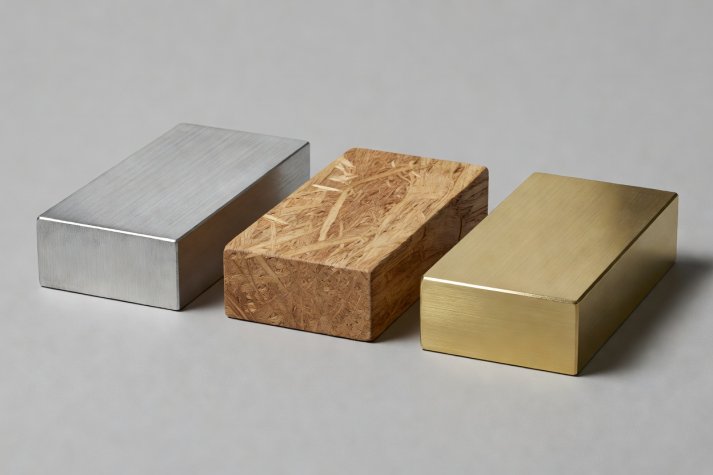
Smelted using Norwegian hydroelectric power (such as Norsk Hydro's CIRCAL 75R alloy containing a minimum of 75% post-consumer scrap), anodized 6063 aluminum doubles as both the structural housing and the passive radiative heatsink for internal power electronics.
-
Uncoated Brass for High-Touch Points
Used on toggle levers, rotary encoder knobs, and threaded tripod or stand collars. Brass has natural antimicrobial properties, machines to tight tolerances for smooth thread engagement, and develops a stable oxide patina where fingers touch it daily.
-
Wood-Fiber & Cellulose Biocomposites
Developed by Finnish and Swedish material labs (such as Sulapac and Stora Enso's biocomposite grades), these injection-moldable pellets blend certified wood fibers with bio-based binders. They offer high acoustic damping—reducing plastic resonance in speaker cabinets—and feel warm to the touch in cold rooms.
Acoustic Textiles and Tempered Glass
Where radio frequency (RF) transparency is required—because solid metal blocks Bluetooth, Wi-Fi, and Thread signals—Nordic makers frequently pair recycled polymer frames with woven wool grilles from Danish textile mills like Kvadrat, or tempered soda-lime glass panels.
Wool is naturally flame-retardant without requiring brominated chemical treatments, acoustically transparent across midrange and treble frequencies, and resists static dust buildup far better than synthetic polyester meshes. When tensioned over a removable magnetic frame, a wool grille can be lifted off in two seconds, vacuumed or gently hand-washed, and snapped back into place.
Why Single-Polymer Stamping Matters at End of Life
Even the most repairable electronic tool eventually reaches the end of its working life after ten or fifteen years. Municipal WEEE (Waste Electrical and Electronic Equipment) sorting lines in Sweden, Denmark, and Norway rely on optical near-infrared (NIR) scanners and density flotation to separate plastics.
When a manufacturer glues polyurethane foam, steel mesh, and polycarbonate together into a permanent sandwich, the entire piece must be incinerated for energy recovery rather than mechanically recycled. Devices engineered under Nordic Swan Ecolabel guidelines mold clear ISO 11469 polymer codes (such as >PC+ABS-FR(40)<) into every shell piece and attach metal grilles with spring clips rather than hot-melt adhesive.
Comparing Enclosure Choices Across 10 Years
| Material System | Thermal Conductivity | RF Transparency | 5-Year Surface Behavior | End-of-Life Recovery |
|---|---|---|---|---|
| Anodized 6063 Recycled Aluminum | High (~200 W/m·K) — ideal for GaN & amps | Blocks RF (requires antenna window) | Unchanged; minor edge burnishing | 95%+ remeltable without quality loss |
| Wood-Fiber Biocomposite | Low (insulating, warm to hand) | Full RF transparency | Matte grain hides micro-scratches | Mechanical grind or industrial recovery |
| Soft-Touch Coated ABS (Avoided) | Low | Full RF transparency | Turns sticky via ester hydrolysis | Coating contaminates ABS recycle stream |
| Tempered Glass + Aluminum Frame | Moderate | Full RF transparency | Zero chemical wear; wipe clean | Separate via screw frame disassembly |
Selecting honest materials is half of physical longevity; the other half is how those parts are held together. In Repair Before Replacement, we look at fasteners, modular sub-boards, and spare part availability.