Everyday Devices: Less Friction
The everyday task improved: Adjusting room light, checking a kitchen timer, or powering three tools at a workbench without unlocking a smartphone, dismissing a firmware popup, or hunting for a proprietary charging brick.
A curious inversion occurred in consumer electronics over the past decade: simple two-second tasks were moved behind capacitive glass screens and companion apps. Turning down a bedside radio or dimming a portable reading lamp began requiring four taps and a Bluetooth pairing handshake. Across Scandinavia, industrial designers and embedded engineers have pushed back against this trend, returning to single-purpose physical controls backed by modern solid-state efficiency.
Why Physical Detents Beat Capacitive Glass
Consider how a kitchen timer, workshop audio monitor, or desk lamp is actually operated. Hands are often wet, covered in flour, cold from cycling in November rain, or occupied holding another tool. Capacitive touch panels fail under moisture and offer zero muscle-memory reference; the user must stop what they are doing, look directly at the surface, and confirm whether the tap registered.
Stockholm studios such as Teenage Engineering and Malmö audio makers like Transparent have demonstrated that mechanical Alps rotary encoders, knurled aluminum thumbwheels, and heavy toggle switches are not nostalgic decorations—they are functional upgrades. An optical or Hall-effect rotary encoder rated for 1,000,000 revolutions lets a user adjust volume or light temperature by feel alone. When paired with a transflective memory-in-pixel LCD or electrophoretic e-paper display, the device remains legible under bright studio skylights while drawing less than 15 microwatts when static.
Three Questions We Ask Every Portable Device
-
Can it be operated with eyes closed or wearing wool gloves?
If the primary action (on/off, brightness, mute) cannot be found by finger contour alone, the enclosure geometry needs revision.
-
Does it charge from any standard USB-C PD cable?
Many budget USB-C devices omit the two 5.1kΩ pull-down resistors on the CC pins, failing to charge when connected to a true USB-C to USB-C laptop charger.
-
What happens when the battery degrades in year four?
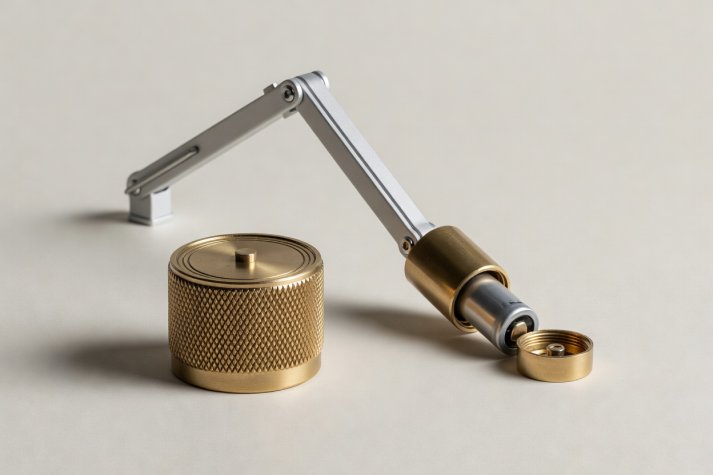
A knurled brass end-cap hiding a protected 21700 or 18650 cell turns a dead lamp into a thirty-second renewal rather than electronic waste.
Cordless Lighting Without Disposable Batteries
Dark Nordic winters make portable indoor-outdoor lamps one of the most heavily used household categories in Denmark, Norway, Sweden, and Finland. Historically, cordless table lamps suffered from two flaws: sealed lithium-polymer pouches soldered directly to the main PCB, and cold-white LED emitters with poor color rendering (CRI below 80) that make timber interiors look sterile.
Newer iterations from Nordic lighting engineers address both issues simultaneously. High-CRI (95+ Ra) warm-dimming COB LED arrays replicate the 2200K–2700K spectrum of candlelight while drawing just 1.8 watts at reading brightness. More importantly, housing the battery inside a threaded aluminum tube at the base lowers the lamp's center of gravity—preventing wind tip-overs on summer balconies—and lets the owner unscrew the base plate to swap in standard lithium-iron-phosphate (LiFePO4) or 18650 cells bought from any electronics supplier.
Desktop Power Delivery: Thermal Honesty
Gallium nitride (GaN) transistors have allowed power supplies to shrink dramatically, yet ultra-miniature chargers often run at surface temperatures exceeding 72°C. High internal heat dries out electrolytic smoothing capacitors prematurely, cutting the operational lifespan of a tiny wall wart in half.
The most sensible Nordic desk power blocks resist the race to be as small as a matchbox. By retaining a slightly larger extruded aluminum heatsink chassis and resting flat on the desk via a replaceable IEC C5 ("cloverleaf") or C7 figure-eight mains cord, internal capacitor temperatures stay 18°C cooler under a sustained 100W laptop load. If a user travels from Oslo to London, they simply swap the standard mains cord rather than stacking heavy plug adapters onto a wall socket.
| Device Archetype | Useful Specification | Resource & Maintenance Reality |
|---|---|---|
| Desk GaN Power Hub (100W–140W) | IEC C7 detachable mains lead; per-port overcurrent reset | Keep vents dust-free; thermal pads last 8+ years at <55°C |
| Cordless Reading Lamp | 95+ CRI warm LED; threaded bay for dual 18650 cells | Cells cost ~€12 to replace every 5–6 years; clean brass contacts |
| Field Audio Recorder / Synth | Hall-effect encoders; AA NiMH or USB-C PD hybrid power | Zero pot scratchiness; mechanical switch caps snap on/off |
| E-Paper Desk Clock & Hygrometer | Sensirion SHT4x sensor; 2x AA lithium cells (4-year life) | Vacuum sensor vents yearly so lint does not slow humidity reading |
Next in our series, we examine how these same principles of local control and low standby draw scale up to an entire apartment or timber house in Connected Homes, Clear Choices.